.png)
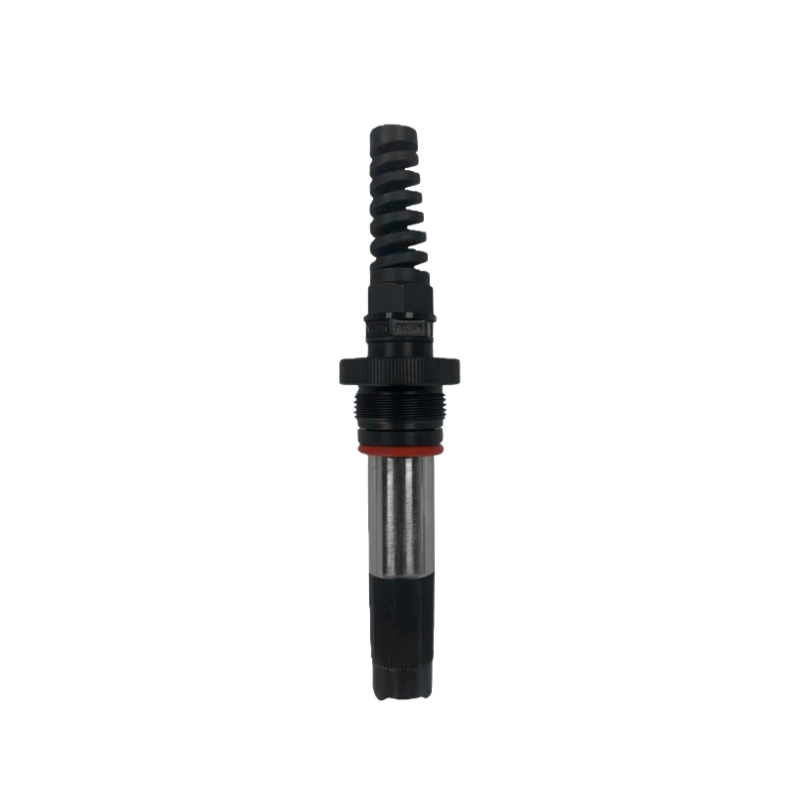
The TS-280 polarographic (Clark type) residual chlorine electrode is precise and allows live HOCl and residual chlorine testing. Clark principle cathodes have anodes, cathodes, electrolytes, and gas-permeable PTFE sheets. POM membrane and stainless steel make the electrode clean and durable. Swimming pools, drinking water, factory process water, and other areas contain chlorine. The water disinfection sensor is sensitive, accurate, and inexpensive to maintain.
★★★★★
Features
- Has stable zero point performance to ensure accurate and reliable measurement;
- Simple structure and easy to clean;
- Suitable for measuring residual chlorine, chlorine dioxide, and ozone in water.
Measuring principle
The TS-280 residual chlorine electrode is a diaphragm type polarographic sensor consisting of a cathode, an anode, an electrolyte, and a gas permeable thin film covering the cathode. The residual chlorine in the measured liquid diffuses through the diaphragm to the cathode, and an appropriate polarization voltage between the cathode and anode can reduce the residual chlorine on the cathode. These chemical reactions generate a current proportional to the residual chlorine in the measured solution.
Parameters
| Category | Specifications |
|---|---|
| Measurement Principle | Polarographic (Clark-type) with gas-permeable membrane |
| Measurable Parameters | Residual Chlorine, Hypochlorous Acid (HOCl); Trace HOCl/Residual Chlorine (optional) |
| Measuring Range | Standard: 0.05-20 ppm; Trace version: 0.01-5 ppm |
| Polarization Time | First use: 30 minutes; Subsequent use: 10 minutes (standard); First use: 90 minutes; Subsequent use: 45 minutes (trace) |
| Operating Conditions | Temperature: 2-45℃; pH Range: 4-8.2; Maximum Pressure: 0.1 MPa (1 bar) |
| Temperature Compensation | Customizable thermistor resistance |
| Response Time | T90 < 2 minutes (room temperature); T95 < 5 minutes (room temperature) |
| Physical Specifications | Diameter: 20mm; Length: 70mm; Mounting Size: M28×1.5 thread or G3/4 thread (optional) |
| Material | Housing: Stainless steel; Membrane Cap: POM; Membrane: PTFE |
| Cable Configuration | 3m (standard) / 5m (TS-280-5M) high-impedance low-noise shielded cable |
| Minimum Flow Rate | 200-250 mL/min; Flow-through installation: ≥30 L/h |
| Wiring Definition | Temperature wire (white), Temperature wire (green), Metal shield wire, Transparent central axis wire (conductive rubber must be stripped) |
Core Highlights
- Polarographic technique makes it possible to quickly respond and accurately assess low concentrations (0.01–5 ppm) in trace form.
- The PTFE membrane reacts to different types of water and is resistant to damage and contamination. The stainless steel housing makes the structure more stable.
- Installation is easy because the calibration is simple, there isn’t much upkeep needed, and you may choose the thread size.
- Stable Performance: Current production is based on the amount of residual chlorine, and the temperature correction can be changed to keep things consistent.
Featured Applications
- In the field of drinking water: online monitoring of residual chlorine/hypochlorous acid in waterworks, secondary water supply, and bottled water production;
- Industrial scenario: Cooling circulating water, pre-treatment of process water, monitoring of industrial wastewater disinfection compliance;
- Real time control of residual chlorine in public places such as swimming pools, hot springs, and central air conditioning cooling towers in hotels;
- Low concentration special project: precise monitoring of low concentration disinfection residues in ultrapure water and food and beverage production.
Electrode diagram illustration
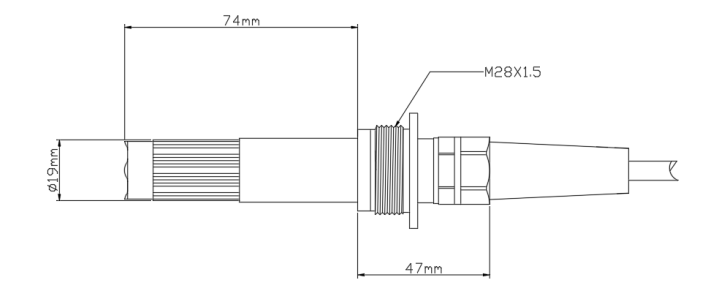
- After opening the packaging, check for mechanical damage to the electrode cap and electrode body;
- Select the corresponding electrode sleeve or cable head for installation according to different electrodes;
- The connection between the electrode wire and the electrode is not waterproof, please make sure to do a good job of waterproofing.
Wire stripping instructions
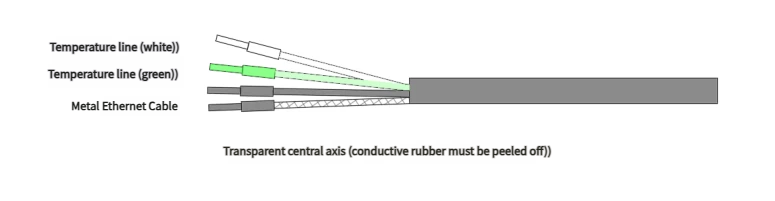
Attention
- The outer layer of the transparent central axis is covered with a conductive rubber layer and a metal mesh layer. When stripping, first peel off the metal mesh layer into the metal mesh as shown in the figure, and be sure to remove the conductive black skin of the transparent central axis;
- The cable extends to the host without any contact points except for a dedicated junction box.
Daily maintenance and precautions
Maintenance points
- When installing, choose matching protective sleeves or cable connectors to ensure that the threaded interface is tightly sealed and avoid water leakage.
- The connection between the electrode wire and the electrode is not waterproof, and waterproof treatment should be done to avoid moisture affecting signal transmission.
- When stripping the wire, it is necessary to peel off the metal mesh layer, thoroughly remove the conductive black skin on the outer layer of the transparent central axis, and there should be no additional contacts in the middle.
- Avoid electrode contact with sharp objects to prevent membrane damage; The installation location should be away from strong magnetic fields and mixers to ensure stable measurement.
- Before the first use, it is necessary to connect polarization with the host and complete zero and slope calibration according to the host calibration process to improve measurement accuracy.
Safety precautions
- Every three to six months, wash the surface with clean water to get rid of anything stuck on it. This keeps the membrane’s water moving.
- Clean, seal, and store the electrode somewhere dry if you’re not going to use it for a while. The barrier won’t break down because of this.
- It is important to check the cable link and make any changes that are needed to make sure the signal gets through if the test data changes.
- Heavy acid or alkaline liquids can damage electrodes over time, so don’t leave them in them for too long.
Technical Support
Top 6 Industrial Gas Analyzers Manufacturers 2025
6 Best Industrial Gas Detector Manufacturers in the World
9 Best Portable Carbon Dioxide Detector 2025 – Complete Buying Guide
Top 7 portable combustion analyzer Tested
The TS-280 polarographic residual chlorine electrode is the best way to keep track of water disinfection since it is accurate, long-lasting, and dependable. It gives consumers accurate information so they can safely clean drinking water, clean industrial process water, or check the quality of swimming pool water in real time. It is good for a lot of different uses since it has an anti-pollution structure, a flexible standard and micro model options, and is easy to install and maintain.
Request a Quote