.png)
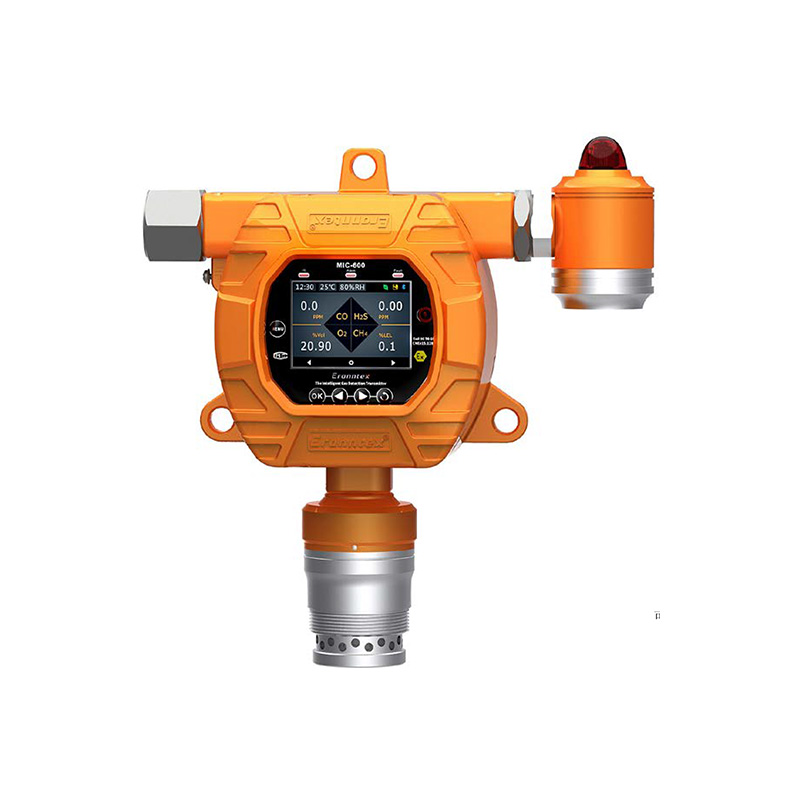
The Fixed Combustible Gas Monitor is used for continuous, real-time online monitoring of the concentration of various flammable and explosive gases in a fixed installation.
Applied to the detection of flammable gas concentrations, it can accurately detect the concentration of flammable gases and display the real-time concentration value on-site. It issues an audible and visual alarm when the concentration of flammable and explosive gases exceeds the standard. The signal is remotely transmitted and synchronously displayed on the monitoring host in the duty room, showing the concentration value and alarm status. It also automatically interlocks to control the exhaust fan for ventilation.
★★★★★
Features
Specifications
| Gas Detection | Combustible gas, Ex. (methane, CH4) |
| Optional: Expandable to 1-6 gas concentrations and temperature/humidity settings | |
| Measuring Range & Resolution | Ex. (CH4): 0-100%LEL, 0.1%LEL, industrial-grade catalytic combustion principle sensor Or Ex. (CH4): 0-1000ppm, 0.1ppm, imported high-precision infrared principle sensor (optional 0-5000ppm, 10000ppm, etc.) Or Ex. (CH4): 0-5%VOL, 0.01%VOL, imported high-precision infrared principle sensor (optional 0-50%VOL, 100%VOL, etc.) Other ranges, scales, principles, and resolutions can be customized. |
| Detection Accuracy | ≤±3% F.S. (higher accuracy available upon request) |
| Repeatability | ≤±2% |
| Linearity | ≤±2% |
| Uncertainty | ≤±2% |
| Response Time | T90 ≤ 20 seconds |
| Recovery Time | ≤ 30 seconds |
| Signal Output | RS485 (Modbus-RTU) bus-based, 4-20mA split-line system. |
| Optional features: 0-20mA, 1-5V, 0-5V, 0-10V, wireless transmission, network transmission, SMS alarm. | |
| Operating Mode | Fixed installation, online detection, diffusion-type measurement; optional pipeline, flow-through, and pump-suction measurement. |
| Display Mode | 1.7-inch high-definition color screen display on-site; optional no on-site display, or optional ERUN-PG32E controller for remote display, control, and alarm. |
| Alarm Mode | Default 1-channel output, optional 2-channel passive contact (dry contact) output, three-level alarm, alarm points can be set. |
| On-site audible and visual alarm. | |
| Installation Method | Pipe-mounted and wall-mounted types. The working pressure for pipe-mounted devices is atmospheric pressure ±30%; pressure reduction is required for pressures exceeding this range. |
| Operating Voltage | 12~30VDC DC; standard power supply for a single unit is 24V, 1A or greater DC regulated switching power supply. |
| Operating Environment | Temperature: -40℃~+70℃; Humidity: ≤10~95%RH (normal) non-condensing environments. |
| For use in condensing environments, customization is required or the operating environment must be specified when ordering. | |
| Electrical Interface | 3/4NPT, optional M20*1.5 internal thread, 1/2NPT |
| Connecting Cable | For 4-20mA, select a three-core shielded cable; for RS485, select a four-core cable. For distances exceeding 1000 meters, the diameter of a single wire should be ≥1.5mm; the shielding layer should be grounded. |
| Protection Class | IP65 waterproof and dustproof rating. |
| Explosion-proof Type | Explosion-proof type, Ex d IIC T6 Gb (gas explosion-proof); Ex tD A21 IP65 T80℃ (dust explosion-proof) |
| Dimensions | 210×170×85mm (L×H×W) |
| Weight | 1600g |
Combustible Gas Sensors and Their Working Principles
Combustible gas detection sensors primarily operate on three principles: catalytic combustion, infrared, and semiconductor. We will now introduce the characteristics of each principle.
Catalytic Combustion Principle
Catalytic combustion sensors are commonly used in the %LEL range. Their main component is two bridge arms composed of two pairs of bridges. When the gas sensor comes into contact with a combustible gas, the resistance within the bridge changes, causing a change in the bridge’s output voltage. The magnitude of the output voltage is directly proportional to the combustible gas concentration. Some catalytic combustion sensors also incorporate a compensation reference compensator to effectively prevent signal degradation caused by environmental changes, ensuring the overall bridge output is proportional to the concentration.
The characteristics of this type of sensor are stable signal, zero-point stability, good repeatability, and a lifespan of approximately 3 years.
Infrared Principle
Infrared gas sensors are mainly designed for specific gases. Not all combustible gases can be detected using infrared principles; only certain flammable gases can be detected using infrared sensors. These include point-type gases such as methane, ethane, and propane.
It primarily utilizes non-dispersive infrared (NDIR) light to detect combustible gases in the air. This sensor uses the absorption characteristics of the near-infrared spectrum and the absorption intensity relationship with the combustible gas concentration to determine the gas concentration. It is highly identifiable and can accurately identify the concentration of the target gas in complex background gases.
The main advantages of this type of sensor are its fast response speed, high repeatability, and integrated temperature compensation. Its lifespan is generally over five years, making it superior to catalytic combustion generation products. The sensor outputs an analog signal, which is converted into a gas concentration change by the detector’s A/D conversion circuit.
Metal Oxide Semiconductor Sensors
Metal oxide semiconductor sensors are most commonly used for ppm-level measurements. They consist of three parts: a heating circuit, a load circuit, and a power supply circuit. After the semiconductor device is heated to a stable temperature using the heating circuit, when combustible gas comes into contact with the sensor, the sensor’s conductivity increases with the increase in combustible gas concentration, forming an output signal proportional to the combustible gas concentration. The gas-sensitive material used in this type of sensor is primarily tin dioxide.
The lifespan of this type of sensor can be up to 10 years. The disadvantages are poor stability, long aging time, and large zero-point drift, so it is often used in civilian combustible gas detectors.
Technical Support

Expert Guide: How a Photoionization Detector Works
CO2 Sensor vs. VOC Sensor: What’s the Difference?

7 Critical Mistakes in Gas Sampling System Design: A Practical Checklist

Buyer’s Guide: 7 Critical Checks for Selecting a Chlorine Gas Detector
As a professional manufacturer with many years of experience in the gas detection field, Sino-Inst consistently provides reliable combustible gas detection solutions for various industries. Covering multiple sensor types including catalytic combustion and infrared, it can accurately detect over 500 combustible gases such as methane, hydrogen, and propane, suitable for all scenarios including petrochemical plants, gas stations, kitchens, and coal mines.
Request a Quote
Related Products


Fixed Combustible Gas Monitor | Sino-Inst
The Fixed Combustible Gas Monitor is used for continuous, real-time online monitoring of the concentration of various flammable and explosive gases in a fixed installation.
Product SKU: Fixed Combustible Gas Monitor
Product Brand: Sino-Inst
Price Valid Until: 2099-09-09
Product In-Stock: PreOrder
5