.png)
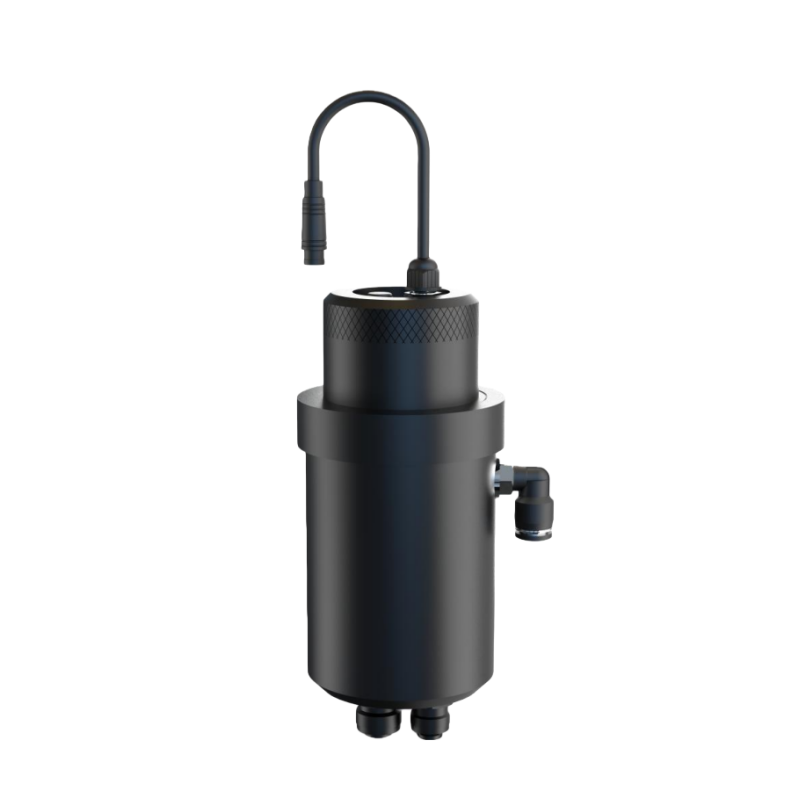
Self-developed pocket-sized turbidity sensor DSS-220-10M has a low range. The 880nm LED light source and 90-degree dispersed light concept properly measure water turbidity. The tiny, easy-to-integrate device features automated range switching from 0 to 5/20/100NTU, a measuring lower limit of 0.002NTU, and a closed pressured flow route design (0.05~0.5MPa) for water sample recovery.
The rapid reaction, low drift, and maintenance-free device is extensively utilized for online monitoring of low turbidity water scenarios such direct drinking water, tap water, secondary water supply, and industrial process water.
★★★★★
Features
- Compact size, easy to integrate;
- Fast response time, able to quickly and accurately monitor changes in water samples;
- Good reproducibility, not affected by flow rate and pressure;
- High sensitivity, low measurement limit, can accurately measure turbidity below 0.1NTU;
- Closed pressurized flow path, capable of withstanding a maximum pressure of 5 kilograms, and capable of water sample recovery;
- Not easy to scale, with good defoaming effect, equipped with automatic drainage, and maintenance free for a long time.
Parameters
| Category | Specifications |
|---|---|
| Measurement Principle | 880nm LED light source, 90° scattered light detection method |
| Range & Accuracy | Range: 0~5/20/100NTU (auto-ranging); Accuracy: ±5% or ±0.1NTU (whichever is larger), based on Formazin primary standard solution at 25℃ |
| Core Performance | Detection limit: 0.002NTU; Repeatability: ±1% or 0.006NTU (whichever is larger); Response time: T90<30S (from sample entry) |
| Water Sample Requirements | Temperature: 0~40℃ (non-freezing); Flow rate: 0.5~2L/min; Pressure: 0.05~0.5MPa |
| Environmental Conditions | Temperature: 5~40℃; Relative humidity: 5%~95% (non-condensing) |
| Signal & Power Supply | Standard: RS485 Modbus RTU; Optional: 4-20mA; Power supply: 9-24VDC; Power consumption: <0.8W |
| Physical Specifications | Material: POM/316L stainless steel; Dimension: φ78×180mm; Installation: Wall-mounted horizontal |
| Core Functions | Automatic light intensity adjustment, automatic blowdown, low/high concentration calibration; Unaffected by flow rate and pressure fluctuations |
Core Highlights
- Ultra precise low range monitoring: With a measurement limit as low as 0.002NTU, it can accurately capture turbidity changes below 0.1NTU and is suitable for high standard scenarios such as direct drinking water.
- Design of pressurized flow path: with a pressure range of 0.05~0.5MPa, achieving water sample recovery and water conservation. The closed structure has good defoaming effect and is not easy to scale.
- Convenient integration and maintenance: compact in size, wall mounted, supports RS485 communication (Modbus RTU protocol), comes with automatic drainage function, and requires no maintenance for a long time.
- Stable anti-interference: The automatic adjustment technology of light intensity reduces drift, is not affected by flow rate and pressure fluctuations, and has strong data repeatability.
Featured Applications
- Direct drinking water and water treatment plants: online monitoring of low turbidity in raw and filtered water to ensure that the water quality meets the standards;
- Secondary water supply and end-point water in the pipeline network: real-time tracking of water turbidity to prevent secondary pollution;
- Swimming pool water and industrial process water: transparency monitoring of swimming pool water quality, turbidity control of industrial production process water;
- Other low turbidity demand scenarios: such as ultrapure water preparation and water monitoring for food and beverage processes.
Daily maintenance and precautions
Installation and operation points
- Installation requires horizontal wall mounting, and sampling points should be selected on the side or center of the pipeline to avoid interference from sediment and bubbles;
- The pipeline connection needs to control the water pressure to be ≤ 0.5MPa and the flow rate to be 0.5-1.5L/min, equipped with manual valve adjustment;
- When wiring, turn off the power. The RS485 signal corresponds to red (VCC), black (GND), green (B -), and yellow (A+), and the optional 4-20mA corresponds to orange (+) and white (-);
- Calibration supports two-point calibration for low concentration (≤ 1NTU water sample) and high concentration (20NTU standard solution), which is completed by writing the calibration value into the register.
Daily maintenance and troubleshooting
- Maintenance: Regularly check the pipeline, clean the light source lens (avoid touching with hard objects), increase the cleaning frequency when the water quality is poor, and regularly compare and calibrate;
- Fault handling: RS485 communication abnormality requires checking the wiring. Abnormal increase in turbidity value may be due to lens dirt or incorrect pipeline connection, and cleaning or recalibration is needed; The leakage of the circulation channel requires reducing the water pressure to the specified range.
Technical Support
Top 6 Industrial Gas Analyzers Manufacturers 2025
6 Best Industrial Gas Detector Manufacturers in the World
9 Best Portable Carbon Dioxide Detector 2025 – Complete Buying Guide
Top 7 portable combustion analyzer Tested
DSS-220 pressure type low range turbidity sensor is a professional choice for low turbidity monitoring scenarios. With a 0.002NTU ultra-low measurement limit and automatic range switching function, coupled with an 880nm LED light source and a 90 degree scattered light principle, it accurately captures subtle changes in water quality and provides stable and reliable data.
From compliance monitoring to process optimization, it provides strong support for water quality management with its advantages of precision, stability, and peace of mind, helping to efficiently control water quality safety and empowering precise operation and maintenance in various scenarios.
Request a Quote