.png)
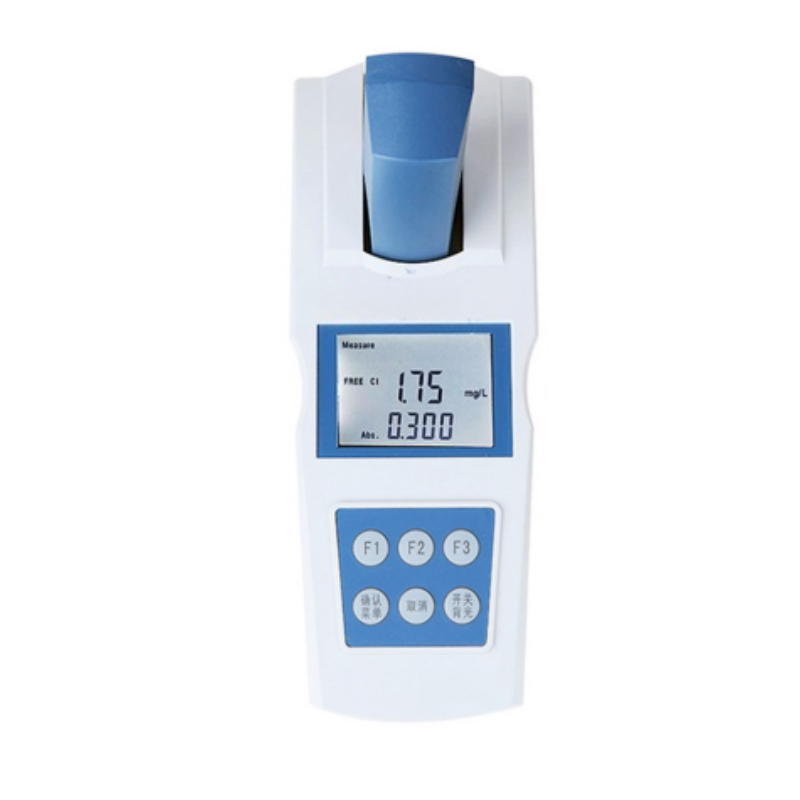
Instead of a convoluted optical route, the DGB-402A portable residual chlorine/total chlorine analyzer employs a 515nm LED light source and DPD colorimetry. Small, portable, and user-friendly. The instrument features a calibration curve and can be measured without calibration. It measures total and residual chlorine accurately and has calibration functions. It provides reliable, up-to-date data for monitoring water disinfection, environmental compliance, and immediately identifying issues in surface water, industrial effluent, drinking water, swimming pool water, and more.
★★★★★
Features
- The wavelength is 515nm, using new LED measurement technology, with a simple structure, stable signal, and high measurement accuracy
- Using DPD method to measure residual chlorine and total chlorine, the measurement method is built-in and simple to use
- Support calibration free measurement, direct reading of measurement results, and automatic locking of readings
- Supports multi-point calibration (up to 5 points) and allows users to edit calibration curves
- Compliant with GLP standards, supporting on-site and retrieval of test results, with a storage capacity of 200 sets of measurement results for each testing item
- Supports two power supply methods: battery powered and USB powered
- Equipped with breakpoint protection function
IP65 protection level, good waterproof and dustproof performance - Support firmware upgrade, allowing for feature expansion and application expansion
Parameters
| Category | Specifications |
|---|---|
| Measurement Principle | DPD colorimetric method, 515nm single-wavelength LED light source detection |
| Measurable Parameters | Residual Chlorine, Total Chlorine |
| Measuring Range | 0.00-3.00 mg/L (Dilution required for samples exceeding the range) |
| Measurement Accuracy | Indication error: ±3% or ±0.02 mg/L (per manual) / ±5% or ±0.05 mg/L (per single-page data, subject to actual product) |
| Key Performance | Detection limit ≤ 0.02 mg/L; Repeatability ≤ 1%; Absorbance resolution 0.001 ABS |
| Operational Functions | Manual/automatic data storage (200 sets), data review/delete, one-point calibration, factory reset |
| Display & Protection | Backlit display; IP65 waterproof and dustproof rating |
| Power Supply | Rechargeable lithium battery (per manual) / 4×1.5V alkaline batteries (per single-page data); USB charging supported |
| Physical Specifications | Dimensions: Approx. 80mm×200mm×75mm (manual) / 190×80×60mm (single-page); Weight: Approx. 0.35-0.4kg |
| Standard Configuration | Colorimetric bottles (25mm diameter), calibration reagent kits, batteries, USB charging cable, user manual |
| Operating Conditions | Ambient temperature: 5.0-35.0℃; Relative humidity: ≤85%; No strong vibration or direct sunlight |
Core Highlights
- Easy to Use: You can see the results immediately away because the curves are already there. You may view the results right away after the color shows up in the colorimetric bottle.
- The LED light source signal is reliable because it only repeats itself less than 1% of the time. It can also identify concentrations as low as 0.02 mg/L, which makes it suitable for finding low levels.
- You can use this device outside and at wastewater sites because it is waterproof and dustproof up to IP65.
- It meets GLP standards and can hold up to 200 sets of data. This makes it simple to keep track of data and write reports.
Featured Applications
- Environmental Monitoring: On-site detection of residual chlorine/total chlorine for compliant discharge of industrial wastewater, medical wastewater, and surface water, quickly identifying pollution hazards.
- Drinking Water Safety: Pipeline inspections of water treatment plants, terminal water quality sampling of secondary water supply, residual chlorine monitoring in bottled water production.
- Public swimming pools and hot springs can now really see if there is any chlorine left over, which helps keep people safe.
- Industrial Sites: adjusting the amount of disinfectant used and checking right away to see how well it cools both process water and running water.
Daily maintenance and precautions
Maintenance points
- When installing, choose matching protective sleeves or cable connectors to ensure that the threaded interface is tightly sealed and avoid water leakage.
- The connection between the electrode wire and the electrode is not waterproof, and waterproof treatment should be done to avoid moisture affecting signal transmission.
- When stripping the wire, it is necessary to peel off the metal mesh layer, thoroughly remove the conductive black skin on the outer layer of the transparent central axis, and there should be no additional contacts in the middle.
- Avoid electrode contact with sharp objects to prevent membrane damage; The installation location should be away from strong magnetic fields and mixers to ensure stable measurement.
- Before the first use, it is necessary to connect polarization with the host and complete zero and slope calibration according to the host calibration process to improve measurement accuracy.
Safety precautions
- Every three to six months, wash the surface with clean water to get rid of anything stuck on it. This keeps the membrane’s water moving.
- Clean, seal, and store the electrode somewhere dry if you’re not going to use it for a while. The barrier won’t break down because of this.
- It is important to check the cable link and make any changes that are needed to make sure the signal gets through if the test data changes.
- Heavy acid or alkaline liquids can damage electrodes over time, so don’t leave them in them for too long.
Technical Support
Top 6 Industrial Gas Analyzers Manufacturers 2025
6 Best Industrial Gas Detector Manufacturers in the World
9 Best Portable Carbon Dioxide Detector 2025 – Complete Buying Guide
Top 7 portable combustion analyzer Tested
Due to its “portability, accuracy, and peace of mind” features, the DGB-402A portable residual chlorine/total chlorine tester meets the need for quick on-site detection. You can get correct data in real time and avoid the limits of the lab. It also makes it easier to find problems in environmental law enforcement, drinking water inspection, and keeping an eye on the quality of public and industrial water.
This tool is great for quickly checking the quality of water because it is waterproof (IP65), has a lot of storage room, and is simple to use.
Request a Quote