.png)
1. Introduction to Gas Flow Dynamics
To achieve optimal efficiency and safety in industrial processes, scientific experiments, or environmental monitoring, engineers must understand exactly how to control the flow rate of gas. The precise measurement and manipulation of fluid dynamics is not a simple task of manually opening or closing a mechanical valve. Gases are highly susceptible to environmental changes, meaning that their physical properties shift continuously within a dynamic piping system. At Sino-Inst, we have spent decades engineering fluid mass measurement and control products designed to conquer these very challenges.
Table of Contents
- 1. Introduction to Gas Flow Dynamics
- 2. Understanding Mass vs. Volume in Gas Measurement
- 3. Core Technologies Used to Control the Flow Rate of Gas
- 4. The Role of Mass Flow Controllers (MFC)
- 5. Integrating Safety and Environmental Monitoring
- 6. Engineering Best Practices and Installation
- 7. Summary Comparison of Flow Control Methods
- 8. Frequently Asked Questions (FAQs)
- 9. Industry References
From our experience, the foundation of any stable fluid transmission system relies on selecting the appropriate intelligent instrumentation. Relying on outdated manual rotameters or uncompensated valves introduces unacceptable margins of error. In modern manufacturing, semiconductor fabrication, and petrochemical refining, the ability to control the flow rate of gas with absolute precision directly dictates product yield, process safety, and overall operational profitability.
2. Understanding Mass vs. Volume in Gas Measurement
When engineers first investigate how to control the flow rate of gas, they frequently encounter the critical distinction between volumetric flow and mass flow. Gases are highly compressible fluids. According to the Ideal Gas Law, a change in ambient temperature or a fluctuation in system pressure will dramatically alter the physical volume of a gas, even if the actual number of gas molecules remains identical.
Attempting to control the flow rate of gas using purely volumetric methods often leads to significant process inaccuracies. For instance, a volumetric meter might read 100 liters per minute at one atmospheric pressure, but if the pressure doubles, the actual mass of the gas passing through the line doubles, even though the volumetric reading might remain mathematically similar depending on the instrument setup. We recommend utilizing mass flow measurement principles because the mass of the fluid remains constant regardless of pressure or temperature shifts. By directly measuring the mass, you ensure that the chemical stoichiometry of your process is perfectly maintained.
3. Core Technologies Used to Control the Flow Rate of Gas
Sino-Inst’s fluid mass measurement and control products are available in three distinct technology types: thermal, differential pressure, and Coriolis. All three types utilize proven and mature technologies, ensuring high accuracy and reliability for Sino-Inst products across varied applications.
Thermal Mass Flow Technology
Thermal technology operates on the principle of heat transfer. A sensor consisting of a heated element and temperature measurement probes is inserted into the gas stream. As the gas flows past the heated element, it carries away heat. The rate of heat dissipation is directly proportional to the mass flow rate of the gas. This technology is highly sensitive and is widely recognized as one of the most effective ways to control the flow rate of gas in low-flow, clean-gas environments like laboratories and semiconductor manufacturing lines.
Internally Compensated Laminar Differential Pressure
Differential Pressure (DP) measurement is a classic method, but Sino-Inst elevates this with internally compensated laminar differential pressure technology. By forcing the gas through a laminar flow element, the turbulent gas is smoothed into parallel layers. The pressure drop across this element is measured. Because we utilize intelligent sensor technology, this pressure drop is instantly calculated alongside real-time temperature and absolute pressure data to output a true mass flow reading. This method provides incredibly rapid response times, making it ideal for processes requiring instant adjustments.
Coriolis Mass Flow Meters
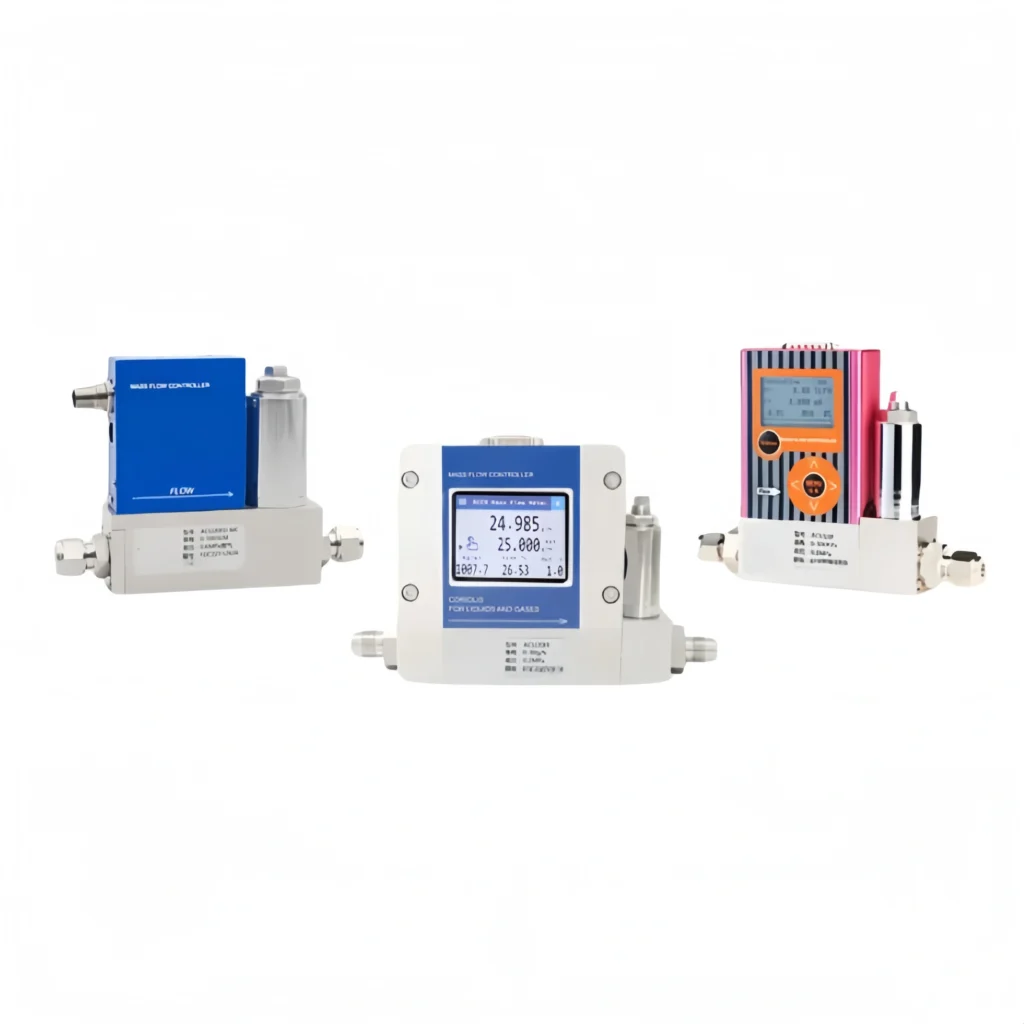
Coriolis meters represent the pinnacle of fluid measurement. They operate by vibrating a measuring tube and observing the phase shift caused by the Coriolis effect as fluid passes through it. The resulting twist in the tube is directly proportional to the true mass flow rate. While often used for liquids, Sino-Inst has optimized this technology for dense gases. When you need to control the flow rate of gas with unparalleled accuracy independent of the fluid’s thermal properties, Coriolis technology is the ultimate solution.
4. The Role of Mass Flow Controllers (MFC)
Measurement is only half of the equation; active regulation is the other. Mass Flow Controllers/Meters are used for the precise measurement and control of gas or liquid mass flow rates. Also known as MFC/MFM, they not only function as mass flow meters but, more importantly, can automatically control gas/liquid flow rates.
This ensures stable fluid transmission at a preset flow rate in industrial processes, scientific experiments, or environmental monitoring. Even with system pressure fluctuations or changes in ambient temperature, the flow rate remains constant at the set value. They offer high measurement accuracy, good sensitivity, and high reliability, and are widely used in various industries. An MFC accomplishes this by integrating a high-precision proportional control valve with the internal sensor and a sophisticated PID (Proportional-Integral-Derivative) loop. To further ensure accuracy, digital display technology is also widely used in the product series, allowing operators to monitor setpoints and actual flow rates seamlessly.
5. Integrating Safety and Environmental Monitoring
When you control the flow rate of gas, especially involving hazardous, toxic, or highly combustible media, system integrity and personnel safety cannot be an afterthought. Controlling the flow strictly inside the pipe requires an equal commitment to monitoring the ambient environment outside the pipe.
We recommend a holistic approach to facility safety. Deploying Fixed Gas Detectors around the perimeter of your flow control stations ensures that any microscopic leak from a fitting or valve is immediately identified. For personnel moving between different control zones, equipping them with Portable Gas Detectors provides a necessary, localized safety perimeter.
Furthermore, for original equipment manufacturers (OEMs) building custom analytical devices, integrating our 800 Series Gas Sensor Module allows for compact, highly sensitive gas detection directly within the machinery. These modules tie perfectly into a larger Gas Monitoring System, which centralizes all environmental data into a single control room dashboard. In environments where solid particulates are also a concern, pairing your gas flow controls with robust Dust Monitors guarantees complete environmental compliance and process purity.
6. Engineering Best Practices and Installation
Having the right equipment is crucial, but from our experience, improper installation will completely negate the precision of high-end instruments. When setting up a system to control the flow rate of gas, several physical parameters must be strictly adhered to.
- Straight Pipe Runs: Ensure there is an adequate length of straight piping before and after the Mass Flow Controller. Turbulence caused by elbows or sudden pipe expansions right before the sensor will skew the readings.
- Upstream Filtration: Gas streams must be clean and dry. We strongly recommend installing sub-micron particulate filters directly upstream of any flow controller to prevent the proportional valve seat from becoming scored or blocked.
- Proper Orientation: While many modern thermal MFCs are somewhat position-insensitive, installing them in the exact orientation for which they were calibrated (typically horizontal) will always yield the highest measurement fidelity.
- Routine Calibration Verification: Even intelligent sensor technology requires periodic auditing. Establish an annual calibration schedule to verify that the zero and span measurements remain within specified tolerances.
7. Summary Comparison of Flow Control Methods
Selecting the best method to control the flow rate of gas depends heavily on your specific application requirements. Below is a comparative summary of the technologies implemented by Sino-Inst.
| Technology Type | Measurement Principle | Primary Advantages | Ideal Applications |
|---|---|---|---|
| Thermal Mass Flow | Heat transfer rate across sensor elements | Excellent for low flow, highly sensitive, minimal pressure drop | Semiconductor manufacturing, laboratory research, clean gases |
| Internally Compensated Laminar DP | Pressure drop across a laminar flow element | Extremely fast response time, intelligent temperature/pressure compensation | High-speed automation, varying pressure environments, industrial burners |
| Coriolis Mass Flow | Phase shift of vibrating tube due to fluid inertia | True mass measurement independent of gas thermal properties, highest accuracy | Custody transfer, dense gases, supercritical fluids, petrochemicals |
8. Frequently Asked Questions (FAQs)
Why does the system pressure affect my ability to control the flow rate of gas?
If you are using a standard volumetric valve, pressure increases compress the gas, putting more mass into the same volume. This alters the actual amount of chemical reactant entering your process. Mass Flow Controllers automatically adjust their internal valves to compensate for these pressure spikes, maintaining a constant mass output.
Can a single device be used to control the flow rate of gas for multiple different gas types?
Yes, many of Sino-Inst’s thermal and differential pressure MFCs feature intelligent sensor technology that includes multi-gas calibration. Operators can select the specific gas type via the digital display, and the controller will instantly apply the correct conversion factors and thermodynamic properties to maintain accuracy.
What is the fail-safe position of a Mass Flow Controller?
From our experience, process safety usually dictates that valves fail to a closed position upon loss of power. Most of our standard MFCs are equipped with normally closed (NC) proportional valves to ensure that the flow of potentially dangerous gases stops immediately during an outage, though normally open (NO) configurations are available for specialized applications.
How do we know if our gas environment requires fixed or portable gas detectors?
We recommend both. Fixed detectors provide continuous, 24/7 localized monitoring of the pipeline network and control stations, while portable detectors protect individual operators who may move into unventilated or confined spaces near the process equipment.
9. Industry References
For further reading on the physics of fluid dynamics and national standards regarding industrial metrology, we refer engineers to the following authoritative sources:
- National Institute of Standards and Technology (NIST) – Fluid Metrology
- U.S. Department of Energy (DOE) – Fluid and Gas System Optimization
Successfully learning how to control the flow rate of gas is an essential discipline in modern engineering. By transitioning away from manual, uncompensated valves and integrating Sino-Inst’s advanced thermal, differential pressure, and Coriolis Mass Flow Controllers, facilities can guarantee absolute precision, stabilize their processes, and drastically improve operational safety.