.png)
In modern industrial automation, pharmaceutical manufacturing, and semiconductor fabrication, the precise control of fluid dynamics is a fundamental requirement. Relying on outdated volumetric flow meters often leads to unacceptable discrepancies in chemical dosing, primarily because volumetric measurements fluctuate wildly with changes in ambient temperature and system pressure. To achieve true consistency, facilities must integrate a Mass flow controller for liquids. By measuring and regulating the actual molecular mass of the fluid passing through the instrument, a Mass flow controller for liquids guarantees that your coating, blending, and dosing applications remain flawless, regardless of environmental variables.
From our experience at Sino-Inst, engineering robust fluid control systems requires an uncompromising approach to sensor accuracy and valve responsiveness. While mastering liquid control is notoriously difficult due to varying viscosities and densities, the underlying technologies have advanced significantly. Many high-end manufacturing processes actually require the precise vaporization of liquids into gases, demanding controllers that can bridge the gap between liquid precursors and vapor delivery. Today, we will explore the six best technologies and specific models that define the current state-of-the-art in fluid and mass flow control. We will prominently feature our proprietary Sino-Inst architectures, which set the industry benchmark for what engineers should demand when specifying any Mass flow controller for liquids or advanced vapor systems.
Table of Contents
- Summary Table: Top Mass Flow Control Technologies
- 1. Sino-Inst SI-20FDR High Accuracy Controller
- 2. Sino-Inst SI-30FC Compact DP Controller
- 3. Coriolis Mass Flow Controller for Liquids
- 4. Thermal By-Pass Mass Flow Controller for Liquids
- 5. Ultrasonic Mass Flow Controller for Liquids
- 6. Capillary Micro-Fluidic Controllers
- Expert Buying Guide: Selecting Your Controller
- Frequently Asked Questions (FAQs)
- References and Industry Standards
Summary Table: Top Mass Flow Control Technologies
To assist process engineers and plant managers in formulating their procurement strategies, we have compiled a summary table detailing the six best categories and specific models of flow controllers. We recommend cross-referencing these specifications with your specific liquid density, vapor pressure, and chemical compatibility requirements.
| Controller Model / Technology Type | Primary Application | Accuracy Profile | Key Architectural Advantage |
|---|---|---|---|
| Sino-Inst SI-20FDR | High-Precision Gas & Vaporized Liquids | ±0.5% F.S. | Dual-valve tandem eliminating flow overshoot |
| Sino-Inst SI-30FC | Compact DP Control for Variable Fluids | ±0.5% F.S. | DSP-based control, zero specific heat capacity error |
| Coriolis Mass Flow Controller for Liquids | High-Viscosity & Variable Density Liquids | ±0.2% of Reading | Measures true mass directly; fluid property independent |
| Thermal Mass Flow Controller for Liquids | Clean, Low-Flow Liquid Dosing | ±1.0% F.S. | Cost-effective thermal bypass sensor technology |
| Ultrasonic Mass Flow Controller for Liquids | Sterile or Highly Corrosive Liquids | ±1.5% F.S. | Non-intrusive transit-time measurement |
| Capillary Micro-Fluidic Controllers | Ultra-Low Flow Pharmaceuticals | ±0.5% F.S. | Exceptional stability at sub-milliliter flows |
1. Sino-Inst SI-20FDR High Accuracy Controller
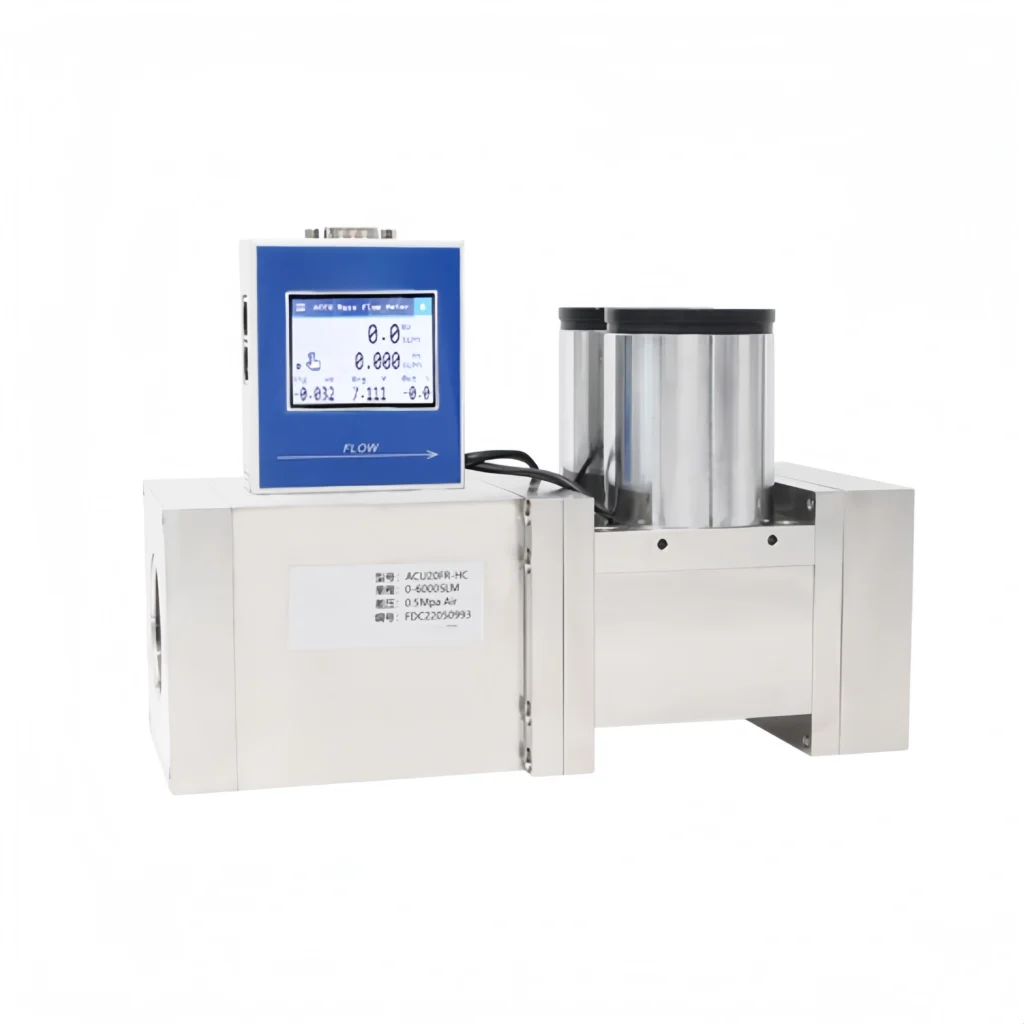
When analyzing the advanced engineering required to build an elite Mass flow controller for liquids, we must examine the pinnacle of fluidic architecture found in the Sino-Inst SI-20FDR. While explicitly categorized as a high-precision gas mass flow controller, the structural breakthroughs within this unit define the gold standard for all fluid phase controls. From our experience, the delivery of liquid precursors that must be vaporized into a gas phase is the most critical juncture in semiconductor manufacturing. The SI-20FDR manages this transition with unprecedented reliability.
The SI-20FDR is engineered for higher measurement control accuracy, typically achieving ±0.5% or even better precision. Its most defining characteristic is its rapid response speed, utilizing dual valves working in tandem to quickly reach setpoints. This design significantly reduces stabilization time and guarantees minimal or zero overshoot. Zero overshoot is one of the primary advantages of dual-valve MFCs, making them particularly suitable for pressure-sensitive applications where a sudden spike in liquid or vapor flow could ruin an entire production batch. The fine-tuning valves are specifically designed for precise adjustments, ensuring stable and accurate control at exceptionally low flow rates (e.g., below 2% of full scale).
SI-20FDR Technical Specifications
- Scalable Range: Available from 0-150 SLM up to a massive 0-6000 SLM across our LC, LM, MC, MM, BC, BM, HC, and HM series models.
- Accuracy & Linearity: ±0.5% F.S with an industry-leading repeatability of ±0.2% F.S.
- Response Dynamics: Unmatched speed ranging from less than 0.1 seconds to 0.8 seconds, depending on the specific flow configuration. Warm-up time is under 5 seconds.
- Turndown Ratio: highly flexible 50:1 and 100:1 options available.
- Digital Integration: Comprehensive compatibility with Modbus, DeviceNet, Profinet, EtherCAT, and Profibus via RS232/485 digital output, alongside traditional 0~5V and 4~20mA analog outputs.
- Rugged Durability: Constructed with a stainless steel base, IP40 protection rating, and seal materials including fluororubber, nitrile rubber, EPDM, and highly resistant perfluoroether. Supports a maximum pressure rating of 3MPa or 10MPa (specified when ordering).
2. Sino-Inst SI-30FC Compact DP Controller
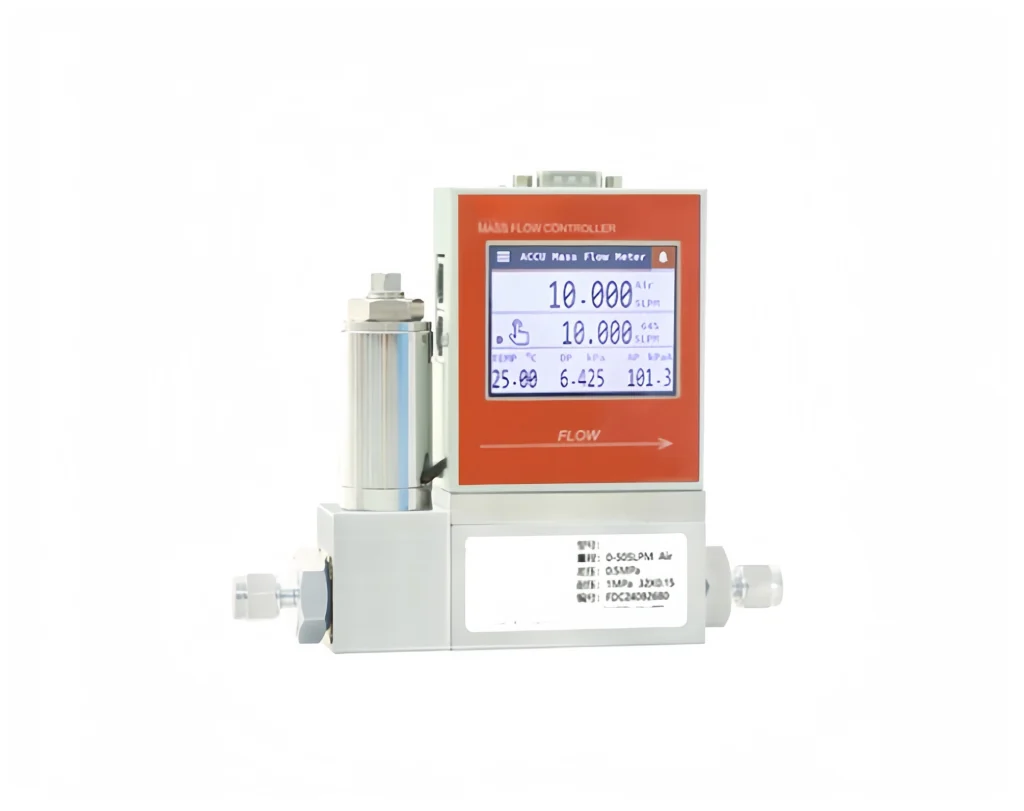
The second entry in our comprehensive analysis is the Sino-Inst SI-30FC. This Compact Differential Pressure (DP) Mass Flow Controller sets an operational standard that every Mass flow controller for liquids strives to achieve: true property independence. One of the most significant challenges in fluid control is compensating for changing temperatures. The SI-30FC eliminates this with its advanced architecture, featuring absolutely no “specific heat capacity” error and providing high-precision real-time data feedback.
We recommend the SI-30FC for research and industrial environments that require immediate operational readiness. It requires no warm-up period, offering zero response lag during measurement. Process operators benefit greatly from the simultaneous display of instantaneous flow rate, cumulative flow, system pressure, and temperature on its built-in monochrome LED/LCD display. The DSP-based (Digital Signal Processing) control system guarantees enhanced accuracy and reliability well beyond standard analog controllers. Furthermore, it supports switching between nearly 100 gases without requiring factory recalibration.
SI-30FC Performance Highlights
- Measurement Range: Broad coverage from 2SCCM up to 300SLM across the SI-30FC-S, SI-30FC-L, and SI-30FC-MC models.
- Accuracy Standards: ±0.5% F.S. with an exceptional temperature coefficient of ±0.015% F.S./℃.
- Control Speed: An incredibly fast response time of just 50 milliseconds.
- Modern Connectivity: Features USB Type-C and Bluetooth connectivity for versatile device integration, alongside standard Modbus, ProfiBus, and DeviceNet protocols.
- Mechanical Connections: Highly adaptable installation with VCR, Ferrule, Quick Connect, Tower, and Flange Mounting options.
3. Coriolis Mass Flow Controller for Liquids
When an application strictly demands a dedicated Mass flow controller for liquids—particularly for fluids with widely fluctuating densities, unknown compositions, or high viscosities—Coriolis technology is the undisputed global standard. A Coriolis Mass flow controller for liquids operates on the physical principle of inertia. As liquid is forced through a continuously vibrating internal tube, the mass of the fluid causes the tube to twist slightly. Highly sensitive sensors measure this minute phase shift, which is directly proportional to the true mass flow rate.
From our experience at Sino-Inst, the paramount advantage of a Coriolis Mass flow controller for liquids is its complete independence from fluid properties. Whether you are controlling the flow of purified water, highly viscous syrups, or aerated petrochemicals, the Coriolis meter measures the actual mass without ever needing recalibration for specific heat capacity or fluid viscosity. While these units typically carry a higher capital cost and demand a larger physical installation footprint than our SI series DP controllers, they are absolutely indispensable in the demanding food, beverage, and heavy chemical industries.
4. Thermal By-Pass Mass Flow Controller for Liquids
For pristine, low-flow liquid applications where budget constraints are a primary consideration, a thermal Mass flow controller for liquids is an excellent alternative. This technology utilizes a precisely heated sensor tube. As the liquid flows past the thermal sensor, it carries heat away. The exact amount of heat dissipated is directly correlated to the mass flow of the fluid, calculated utilizing the specific heat capacity of the target liquid.
We recommend thermal Mass flow controller for liquids for the precision dosing of additives, pharmaceutical fragrances, or ultra-clean industrial chemicals. However, it is vital to understand that unlike the Sino-Inst SI-30FC (which inherently suffers from no specific heat capacity error), thermal liquid controllers must be strictly and precisely calibrated to the exact fluid they are measuring. Any subsequent change in the liquid’s chemical composition or baseline temperature can introduce significant measurement errors unless the controller features advanced algorithmic thermal compensation.
5. Ultrasonic Mass Flow Controller for Liquids
In highly regulated industries such as biopharmaceuticals or semiconductor wafer washing, the fluid must remain entirely free of mechanical contamination. An ultrasonic Mass flow controller for liquids achieves this standard through a completely non-intrusive structural design. By utilizing high-frequency sound waves transmitted diagonally across the flow tube, the controller measures the transit time of the acoustic signals. The minute difference in time between signals sent with the flow of the liquid and against the flow accurately calculates the volumetric rate, which the integrated CPU then converts to mass flow via onboard density sensors.
Because there are absolutely no moving parts and no internal mechanical restrictions, an ultrasonic Mass flow controller for liquids ensures zero pressure drop across the instrument and entirely eliminates the risk of microscopic particle shedding from degrading mechanical seals. They are highly favored for handling highly corrosive acids, bases, and ultra-pure water systems.
6. Capillary Micro-Fluidic Mass Flow Controllers
The final entry in our comprehensive guide addresses the extreme low end of the liquid flow spectrum. A capillary-type Mass flow controller for liquids is meticulously engineered for ultra-low flow rates, often measuring dosages in mere microliters per minute. These advanced controllers utilize a micro-machined capillary bypass system seamlessly integrated with advanced thermal sensing chips.
From our experience, these micro-fluidic units are predominantly utilized in critical medical research, high-performance liquid chromatography (HPLC), and specialized catalytic research. While their total flow capacity is far too low for standard bulk industrial production, their unparalleled precision at the microscopic level makes them a vital technology category when evaluating the full spectrum of a Mass flow controller for liquids.
Sino-Inst Expert Insight: The traditional boundary between gas, vapor, and liquid mass flow control is increasingly blurring in modern smart manufacturing. The dual-valve tandem architectures and DSP-based signal processing found in our SI-20FDR and SI-30FC gas controllers represent the exact technological frameworks driving the next generation of high-precision liquid controllers. Always prioritize procurement of controllers that offer robust digital multi-parameter feedback.
Expert Buying Guide: Selecting Your Flow Controller
Procuring a reliable Mass flow controller for liquids or a high-precision gas/vapor controller requires a deep, analytical understanding of your unique process variables. We recommend rigorously evaluating the following critical parameters before issuing a purchase order.
- Analyze the Turndown Ratio: The turndown ratio strictly dictates the functional range of the controller. For example, our Sino-Inst SI-20FDR offers massive 50:1 and 100:1 ratios. This means a 1000 SLM rated controller can accurately and stably regulate flow down to just 10 SLM, allowing a single instrument to handle both high-volume bulk dosing and critical low-flow fine-tuning.
- Verify the Pressure Drop (ΔP): Every inline controller introduces some degree of flow resistance. You must ensure that your system pump or head pressure can easily overcome the operating differential pressure. Our models operate efficiently within a low 0.05 to 0.5MPa differential, ensuring minimal mechanical strain on your broader fluid delivery systems.
- Seal Material Chemical Compatibility: The chemical aggressiveness and solvency of your fluid dictate your elastomer choice. Sino-Inst offers fluororubber, nitrile rubber, EPDM, and highly resistant perfluoroether to ensure the wetted parts of your controller do not swell, crack, or degrade over years of continuous operation.
- Digital Communication Architecture: In modern Industry 4.0 environments, basic analog 4-20mA signals are rarely sufficient for deep diagnostics. We strongly recommend selecting a controller that natively supports Modbus, DeviceNet, Profinet, EtherCAT, or Profibus protocols for seamless, high-speed PLC integration.
Frequently Asked Questions (FAQs)
What is the functional difference between a volumetric flow meter and a Mass flow controller for liquids?
A volumetric meter measures the physical, three-dimensional space the fluid occupies (such as gallons or liters per minute), which dynamically changes based on ambient temperature and system pressure. Conversely, a Mass flow controller for liquids measures the actual weight and mass of the molecules passing through (such as kilograms per minute), providing a constant, highly accurate measurement regardless of environmental temperature shifts.
Why is a dual-valve system superior for precise fluid control?
From our experience at Sino-Inst, a dual-valve system, exactly as implemented in our SI-20FDR, utilizes tandem valves to rapidly reach demanding setpoints while achieving zero overshoot. One larger valve handles the gross flow adjustments while a secondary fine-tuning valve handles the precise micro-adjustments, completely eliminating the dangerous “hunting” or oscillation effect common in cheaper single-valve controllers.
Can I successfully use a Sino-Inst gas controller for liquids?
The Sino-Inst SI-20FDR and SI-30FC are specifically and masterfully engineered for gas and vaporized liquid phases. While the underlying DSP and DP technologies represent the absolute gold standard for fluid control, direct inline control of dense, non-vaporized liquids requires specialized Coriolis or liquid-specific thermal bypass designs. We recommend always consulting our engineering team to perfectly match the phase state of your media to the correct controller hardware.
What does an IP40 protection rating mean for a mass flow controller?
An IP40 rating, which is standard on our SI series, signifies that the electronic enclosure is fully protected against solid objects larger than 1mm (such as wires, screws, or small tools) but is not protected against liquid water ingress. Therefore, these precision instruments must be installed in controlled, indoor industrial environments or housed within protective secondary enclosures.
References and Industry Standards
- International Society of Automation (ISA) – Comprehensive Standards for Mass Flow Measurement and Control. Visit ISA
- National Institute of Standards and Technology (NIST) – Fluid Metrology, Flow Dynamics, and Calibration Protocols. Visit NIST
- Sino-Inst Internal Engineering and Metrology Data, 2026. Certified empirical data on SI-20FDR dual-valve response times and SI-30FC DSP-based control systems. Visit Sino-Inst