.png)
Accurate fluid measurement is the cornerstone of industrial automation, process control, and custody transfer. Selecting the correct instrumentation directly impacts operational efficiency, regulatory compliance, and bottom-line profitability. However, because industrial fluids range from ultrapure deionized water to highly viscous crude oil, there is no single instrument capable of handling every application. Engineers and plant managers must possess a deep understanding of the various types of liquid flow meter available on the market to make informed procurement decisions.
By Sino-Inst — A professional supplier of industrial process and analytical instruments. We provide customized products, OEM services, and trusted measurement solutions designed to lower your procurement costs without sacrificing industrial precision.
As an industry-leading manufacturer and supplier, Sino-Inst has partnered with facilities across the globe to optimize their process control systems. From our experience, the failure of a measurement system is rarely due to a defective instrument; rather, it is almost always the result of selecting the wrong measurement principle for the specific fluid dynamics at play. We recommend evaluating fluid conductivity, viscosity, temperature, pressure, and required turndown ratio before finalizing any instrumentation purchase. In this comprehensive guide, we will examine the 9 most common types of liquid flow meter, detailing their working principles, ideal applications, and operational limitations.
Table of Contents
- Summary Table: Comparing the Types of Liquid Flow Meter
- 1. Magnetic Flow Meters (Magmeters)
- 2. Coriolis Mass Flow Meters
- 3. Ultrasonic Flow Meters
- 4. Turbine Flow Meters
- 5. Positive Displacement (PD) Flow Meters
- 6. Vortex Flow Meters
- 7. Differential Pressure (DP) Flow Meters
- 8. Thermal Dispersion Flow Meters
- 9. Variable Area Flow Meters (Rotameters)
- Enhancing Measurement with Flow Computers
- Expert Procurement Guide
- Frequently Asked Questions (FAQs)
- Industry References
Summary Table: Comparing the Types of Liquid Flow Meter
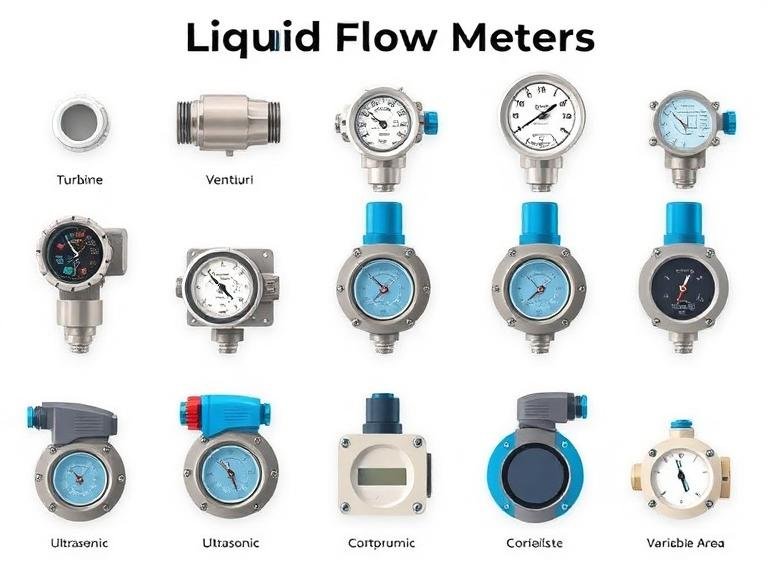
To assist in your initial selection process, the following table summarizes the 9 primary types of liquid flow meter based on their measurement technique, optimal fluid properties, and relative accuracy.
| Flow Meter Type | Measurement Principle | Ideal Fluid Characteristics | Typical Accuracy |
|---|---|---|---|
| Magnetic | Electromagnetic Induction | Conductive liquids, slurries, wastewater | 0.2% to 0.5% |
| Coriolis | Inertia / Mass Mechanics | Varying densities, high value liquids, chemicals | 0.1% to 0.2% |
| Ultrasonic | Transit-Time or Doppler | Clean liquids or liquids with suspended solids | 0.5% to 1.0% |
| Turbine | Mechanical Rotor Speed | Clean, low-viscosity liquids, hydrocarbons | 0.2% to 0.5% |
| Positive Displacement | Volumetric Displacement | High-viscosity liquids, oils, resins | 0.1% to 0.5% |
| Vortex | Von Kármán Effect | Low-viscosity liquids, extreme temperatures | 0.5% to 1.0% |
| Differential Pressure | Pressure Drop across Restriction | General purpose clean liquids | 1.0% to 2.0% |
| Thermal Dispersion | Heat Transfer / Cooling Effect | Low flow rate liquids | 1.0% to 2.0% |
| Variable Area | Float in Tapered Tube | Clean liquids requiring visual indication | 2.0% to 5.0% |
1. Magnetic Flow Meters (Magmeters)
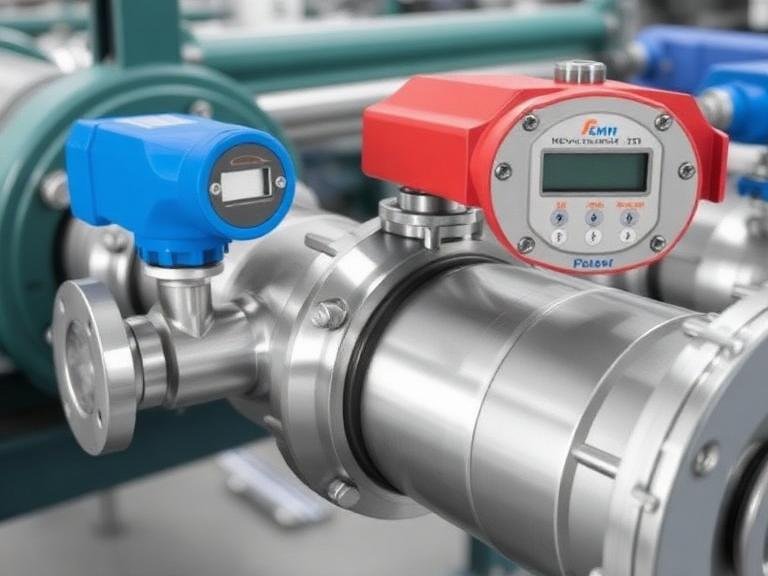
Among the various types of liquid flow meter, magnetic flow meters are heavily relied upon in the water, wastewater, and mining industries. Operating on Faraday’s Law of Electromagnetic Induction, these meters utilize magnetic coils to generate a field across the flow tube. As a conductive liquid passes through this field, it generates a voltage proportional to the fluid’s velocity. Because magmeters feature an unobstructed flow path, they induce zero pressure drop and are virtually immune to clogging, making them the superior choice for aggressive slurries and corrosive chemicals. However, they strictly require a minimum fluid conductivity (typically 5 microsiemens/cm), rendering them useless for hydrocarbons or deionized water.
2. Coriolis Mass Flow Meters
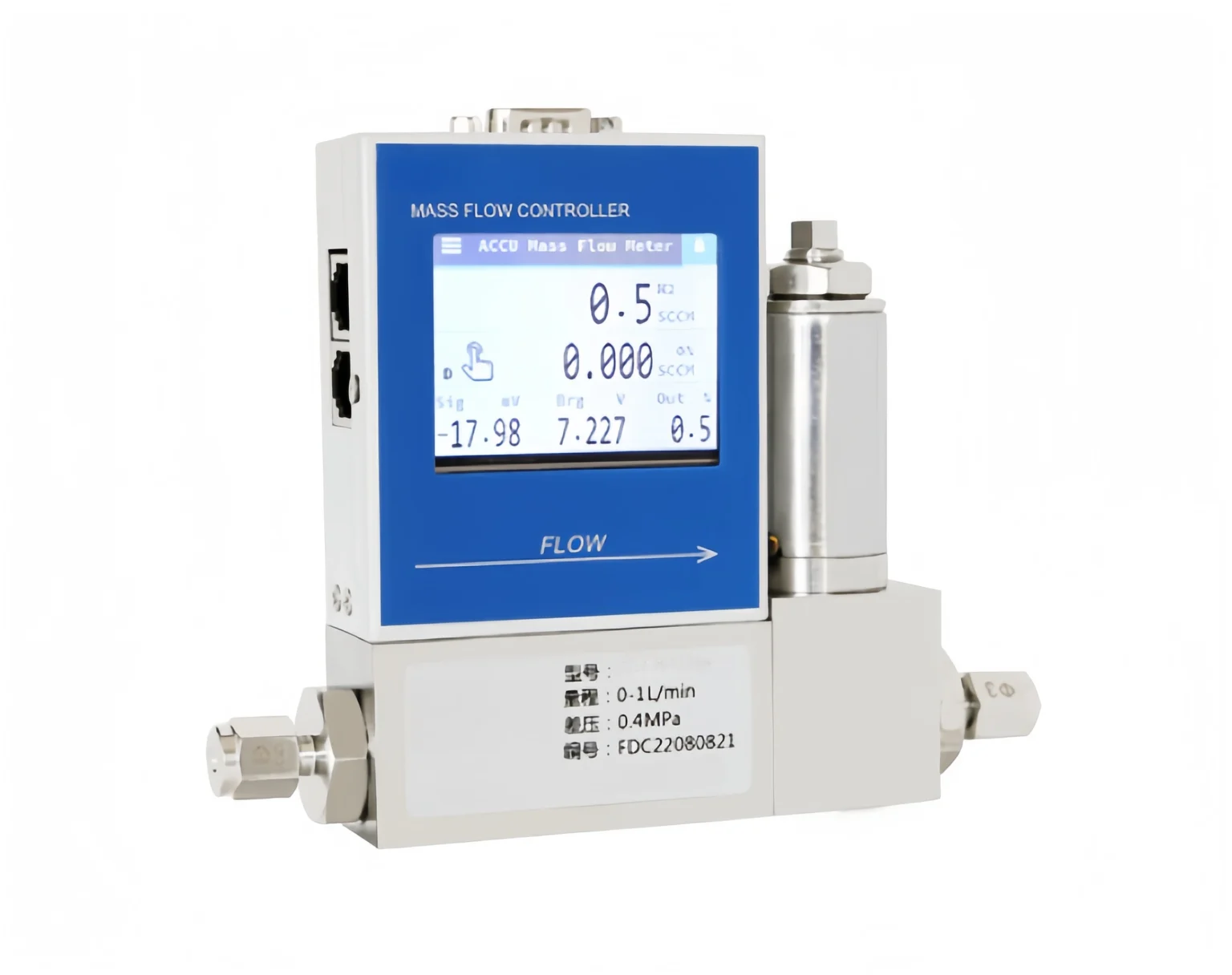
Coriolis meters represent the pinnacle of precision in industrial fluid measurement. Unlike volumetric meters, these instruments measure the direct mass flow rate of a liquid by analyzing the phase shift in vibrating internal tubes caused by the Coriolis effect. This makes them entirely independent of changes in fluid temperature, pressure, viscosity, or density.
From our experience engineering advanced mass flow loops, we highly recommend integrating specialized instruments for low-flow dosing or highly critical chemical injections. The Sino-Inst SI-20FDL Liquid Mass Flow Controller/Flow Meter is specifically engineered based on this mass-measurement philosophy, providing unmatched stability and repeatability in demanding industrial environments where volumetric conversion errors are unacceptable.
3. Ultrasonic Flow Meters
Ultrasonic flow meters are highly versatile non-intrusive instruments. They are categorized into two distinct operational modes: Transit-Time and Doppler. Transit-Time meters calculate flow by measuring the time difference between ultrasonic pulses sent upstream and downstream, making them ideal for highly pure, clean liquids. Conversely, Doppler meters rely on the frequency shift of ultrasonic signals bouncing off suspended particles or gas bubbles, making them suitable for dirty liquids or raw sewage. As one of the most flexible types of liquid flow meter, clamp-on ultrasonic models allow facilities to retrofit measurement points without shutting down the process line or cutting into existing pipework.
4. Turbine Flow Meters
The turbine flow meter is a classic mechanical instrument renowned for its high turndown ratio and excellent repeatability. A multi-bladed rotor is mounted perpendicular to the flow stream. As the liquid pushes against the blades, the rotor spins at a velocity directly proportional to the fluid’s flow rate. A magnetic pickup sensor registers the rotational speed. We recommend turbine meters strictly for clean, low-viscosity liquids such as light hydrocarbons, filtered water, and cryogenic fluids. Introducing abrasive particulates or highly viscous fluids will rapidly degrade the bearings and cause severe measurement drift.
5. Positive Displacement (PD) Flow Meters
When dealing with high-viscosity fluids like crude oil, heavy syrups, polyurethanes, and resins, traditional velocity-based meters fail. Positive displacement flow meters isolate and count exact volumes of fluid using rotating mechanical components (such as gears, oval gears, or nutating disks). Because PD meters do not rely on velocity profiles, they do not require straight pipe runs upstream or downstream. They are one of the only types of liquid flow meter whose accuracy actually improves as fluid viscosity increases, due to the reduction of internal slippage between the mechanical tolerances.
6. Vortex Flow Meters
Vortex shedding flow meters operate on the Von Kármán effect. A bluff body (a non-streamlined obstacle) is placed in the center of the flow stream. As the liquid passes this obstacle, it generates alternating low-pressure vortices downstream. The frequency of these shedding vortices is directly proportional to the fluid velocity. Vortex meters contain no moving parts and are exceptionally rugged, making them suitable for high-temperature liquids and thermal transfer fluids. However, they struggle to measure very low flow rates, as the vortex shedding phenomenon ceases when the fluid velocity drops below a specific Reynolds number threshold.
7. Differential Pressure (DP) Flow Meters
Differential pressure flow meters are arguably the most historically established types of liquid flow meter. They function by inserting a primary element (such as an orifice plate, Venturi tube, or Pitot tube) into the pipe to create an artificial constriction. This constriction causes a pressure drop that is measured by a secondary DP transmitter. According to Bernoulli’s equation, the square root of this pressure drop is proportional to the flow rate. While incredibly robust and universally understood, DP meters induce a permanent pressure loss in the system and require routine calibration of the impulse lines to maintain accuracy.
8. Thermal Dispersion Flow Meters
Thermal dispersion meters are primarily known for gas measurement, but they are highly effective for measuring very low liquid flow rates. They utilize two temperature sensors: one heated and one unheated reference sensor. As the liquid flows past the heated sensor, it carries away heat. The power required to maintain a constant temperature differential between the two sensors is directly proportional to the mass flow rate of the liquid. These are excellent, highly sensitive types of liquid flow meter for monitoring chemical injection lines and precise dosing applications.
9. Variable Area Flow Meters (Rotameters)
For applications requiring simple, cost-effective visual indication of flow, the variable area flow meter, or rotameter, remains an industry staple. It consists of a vertically oriented tapered glass or plastic tube containing a weighted float. Fluid pushes upward against the float, stabilizing at a point where the upward fluid dynamic force equals the downward gravitational force on the float. While they lack the high-end electronic outputs of Coriolis or Magnetic meters, rotameters are highly reliable mechanical indicators that require absolutely no electrical power to operate.
Enhancing Measurement with Flow Computers

Selecting the appropriate physical flow meter is only half of the engineering equation. Raw flow data—whether analog, pulse, or digital—must be accurately processed, temperature-compensated, and logged for facility control systems. Regardless of which types of liquid flow meter you deploy, integrating a highly capable processor is vital.
At Sino-Inst, we recommend pairing your primary sensing elements with the 10FD-XP Liquid Flow Computer. This advanced computational unit is designed to receive inputs from Turbine, DP, Magnetic, and Coriolis meters. It performs real-time algorithmic compensation for changes in fluid density and temperature, ensuring that the volumetric or mass data transmitted to your SCADA or DCS system is impeccably accurate. By offloading complex calculations to the 10FD-XP Liquid Flow Computer, you guarantee custody-transfer level reporting reliability.
Expert Procurement Guide
From our extensive experience outfitting chemical plants, refineries, and water treatment facilities, we understand that capital expenditure must be justified by operational longevity. When selecting among the various types of liquid flow meter, adhere to the following evaluation protocol:
- Analyze the Fluid Profile: Is the liquid conductive? If yes, a Magnetic meter is highly economical. Is it highly viscous? Eliminate Turbine meters and focus on Positive Displacement or Coriolis.
- Determine Accuracy Requirements: If the application is custody transfer (billing based on volume/mass), the premium cost of a Coriolis meter is easily justified. For simple local monitoring, a Variable Area meter may suffice.
- Evaluate Piping Constraints: Velocity-based meters (Ultrasonic, Turbine, Magnetic, Vortex) require straight pipe runs (typically 10 diameters upstream and 5 downstream) to condition the flow profile. If space is tight, Coriolis or PD meters are required.
- Consider Pressure Drop: Every pump in your facility consumes energy. Meters that obstruct flow (DP, Turbine, PD) create pressure drops that cost money over time. Unobstructed meters (Magnetic, Ultrasonic) offer long-term energy savings.
Frequently Asked Questions (FAQs)
What are the best types of liquid flow meter for highly corrosive chemicals?
For highly corrosive chemicals, we recommend Magnetic flow meters lined with PTFE or PFA and equipped with Hastelloy or Tantalum electrodes. Because Magmeters have no moving parts and the flow tube can be lined with highly inert materials, they resist chemical attack exceptionally well. Ultrasonic clamp-on meters are another excellent option, as they do not touch the fluid at all.
Why is the SI-20FDL categorized as a mass flow controller?
Standard types of liquid flow meter only measure the fluid. The Sino-Inst SI-20FDL Liquid Mass Flow Controller/Flow Meter integrates both a highly precise mass measurement sensor and a proportional control valve into a single unit. This allows it to not only measure the exact mass of the liquid passing through but also dynamically adjust the valve to maintain a precise, user-defined setpoint flow rate automatically.
How does fluid viscosity affect different types of liquid flow meter?
High viscosity dampens the performance of Turbine meters and disrupts the vortex shedding in Vortex meters. However, Positive Displacement meters thrive on high viscosity, as the thick fluid acts as a sealant between the internal mechanical gears, improving accuracy. Coriolis meters also handle highly viscous fluids excellently, provided the pressure drop remains within the system’s pumping capacity.